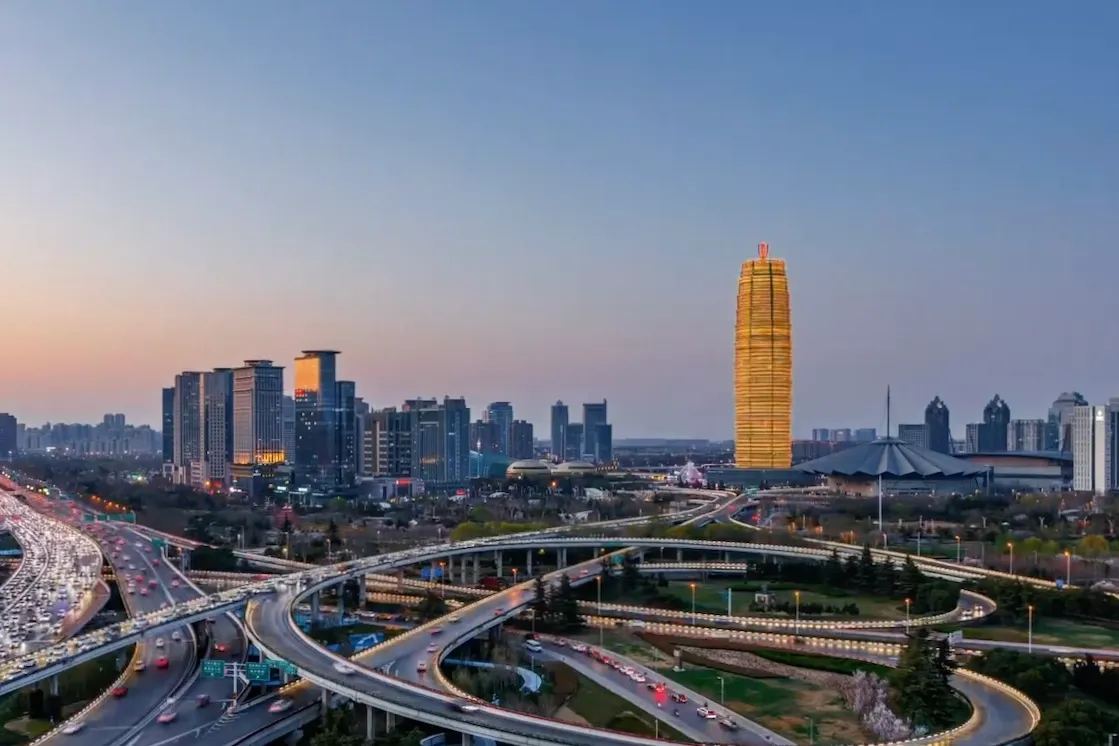
Why this place
Zhengzhou sits at the heart of the North China Plain and is the railway junction where the north-south Beijing-Guangzhou line meets the east-west Longhai line, which is why almost every long-distance train in the country passes through it. The modern city was built on top of a Shang-dynasty capital whose earthen walls still survive in the centre, and its museum holds the bronzes and bone inscriptions that prove the site was a royal town about 3,600 years ago.
People and culture
- Zhengzhou was a capital of the Shang state around 1600 BC; the rammed-earth wall enclosing the old city is still up to ten metres high in places and marks one of the earliest urban defences in the Yellow River basin.
- The Shang royal tomb goods shown in the Henan Museum - bronze vessels, jade and inscriptions on bone - were found near the city and are the clearest evidence that this was a centre of early Chinese power.
- Dengfeng, an hour south in the Song Mountain range, brings together the Shaolin Temple, the birthplace of Chan Buddhism and of the fighting art later called kung fu, and the 13th-century observatory that the Yuan dynasty built to measure the seasons.
- Henan as a whole was the seat of more Chinese dynasties than any other province, and Zhengzhou's position made it the natural modern capital of that heritage - nearby Luoyang, Kaifeng and Anyang were all later capitals.
What to see
- Henan Museum, in the northwestern city, holds the bronzes, jade and bone scripts that trace four thousand years of the plain's history.
- The Shang city wall, still a raised earthen rampart through the urban centre, is free to walk along.
- Shaolin Temple at Dengfeng, about ninety minutes by bus, where the monastic martial-art tradition began.
- The Songyue Temple pagoda near Dengfeng, an unusual twelve-sided brick tower from the sixth century.
- Yellow River scenic area north of the city, with walkways above the broad, silty river.
- Erqi Memorial Tower, the landmark built for the 1923 railway workers' strike in the city centre.
What to eat
- Hui mian - thick wheat noodles in a peppery lamb broth, the everyday Henan staple eaten at any hour.
- Steamed three-treasure dishes, a local way of layering meat, rice and vegetables in one steamer.
- Braised noodles with soybean paste, a heavier city version of the plain's noodle cooking.
- Peanuts and red dates from the surrounding farmland, sold roasted at the stations.
How to plan
Base yourself in Zhengzhou for four days. Day 1: Henan Museum in the morning, then walk the Shang city wall and the Erqi Tower district. Day 2: take the high-speed train or bus to Dengfeng - Shaolin Temple and the Songyue pagoda, returning the same day. Day 3: a day trip to Luoyang for the Longmen Grottoes. Day 4: Kaifeng, with its Iron Pagoda and night market. The high-speed rail links make each excursion under ninety minutes, so the city works as a hub rather than a destination in itself.
Best time
April-May and September-October
Practical tips
- Zhengzhou is the easiest rail hub in central China - every high-speed line stops here, so start and end your plain loop from this station.
- The Henan Museum closes on Mondays; arrive early as the bronze halls fill with school groups by late morning.
- For Dengfeng and the surrounding sites, use the long-distance bus station west of the railway rather than taxis, which quote tourist prices.
This browser has no speech synthesis, so the ▶ buttons stay silent. Everything else works — Chrome, Edge and Safari can read the sounds aloud.