Why this place
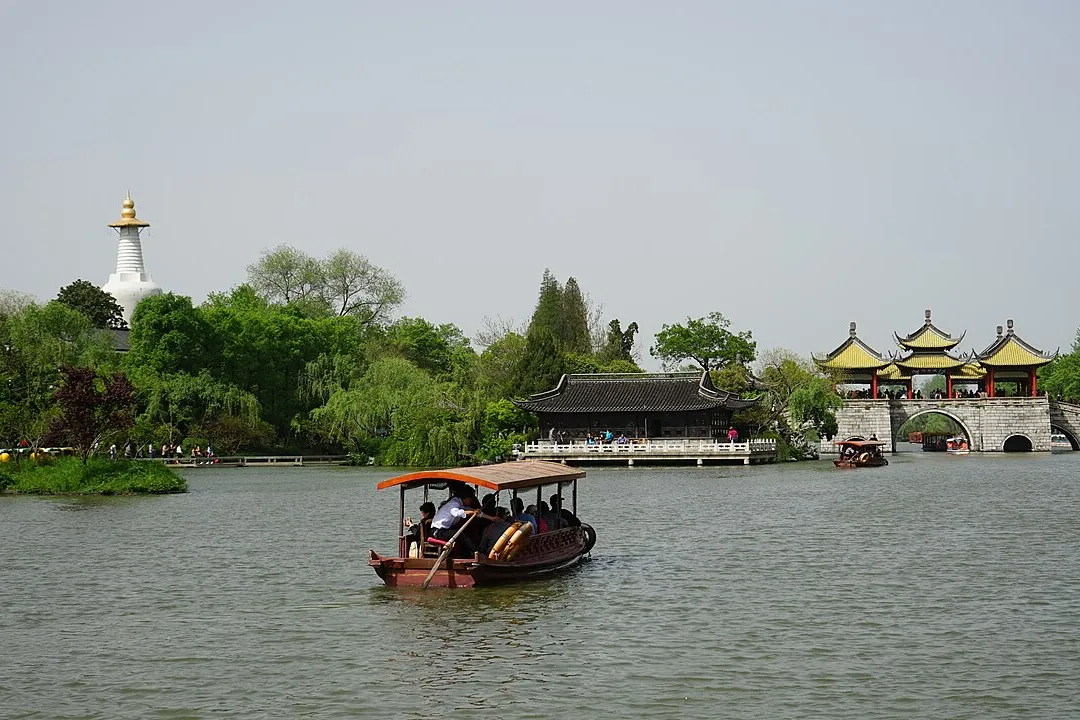
Yangzhou was one of the wealthiest cities in the world in the eighteenth century because salt merchants lived here, and their gardens and teahouses survived the centuries. It is also the home of one of China's most refined cuisines and of a whole tradition of intricate crafts — jade carving, lacquer and paper-cutting. The Slender West Lake is the city's emblem, a linear lake lined with gardens that were built to be walked at a slow pace.
People and culture
- Yangzhou's wealth came from the salt monopoly: the merchants who ran the empire's salt trade in the Qing built gardens, temples and libraries here, and their spending set the local standard of taste.
- The city is the home of Huaiyang cuisine, one of China's four great culinary traditions, famous for knife work — the tofu cut into threads (wensi tofu) is the test of a master.
- Yangzhou was a centre of the scholar arts: its jade carving, lacquerware and paper-cutting were court-quality, and the old craft lanes still teach them.
- The Slender West Lake was shaped over centuries as a parade of gardens and bridges meant to be seen from a boat, which is why it is long and thin rather than round.
- The city sat on the Grand Canal and was a meeting point of north and south, which is why its dialect and food carry both.
What to see
- Slender West Lake (Shouxi Hu) a linear lake lined with gardens, the city's emblem
- The Geyuan Garden, built around a bamboo grove and four rockeries for the four seasons
- Daming Temple and the Jianzhen memorial hall, for the monk who carried Buddhism to Japan
- Dongguan Street and the old canal quarter, with teahouses and craft shops
- The Yangzhou Museum and the Eight Eccentrics gallery, for the local painters
- Heyuan (the Double Garden), a late-Qing merchant residence with a theatre
What to eat
- Yangzhou fried rice the version the rest of the world knows, done properly here with separate grains
- Wensi tofu tofu cut into threads, a test of a chef's knife
- Morning tea (zaocha) Yangzhou's teahouse breakfast is an institution
- The local steamed buns and the salted-pork slivers
How to plan
Give a full day to the Slender West Lake, walking or boating the length of it and stopping at the Geyuan and Heyuan gardens. Morning two is for Daming Temple and the Jianzhen hall, then Dongguan Street for the teahouses and craft shops. Take at least one morning tea sitting — it is a slow meal of small plates that runs for hours. Yangzhou is about an hour from Nanjing and under an hour from Shanghai by rail.
Best time
April–May (the city was built to be visited then) and October–November
Practical tips
- Eat breakfast in a teahouse at least once — it is half the reason to come, and the morning-tea ritual is a slow, social meal.
- The Slender West Lake is best at opening, before the tour boats fill the water; buy the through ticket.
- Yangzhou is an easy day trip from Nanjing or Shanghai by high-speed rail, so you can stay in a bigger city and come for the day.
HSKHSK level 3
This browser has no speech synthesis, so the ▶ buttons stay silent. Everything else works — Chrome, Edge and Safari can read the sounds aloud.