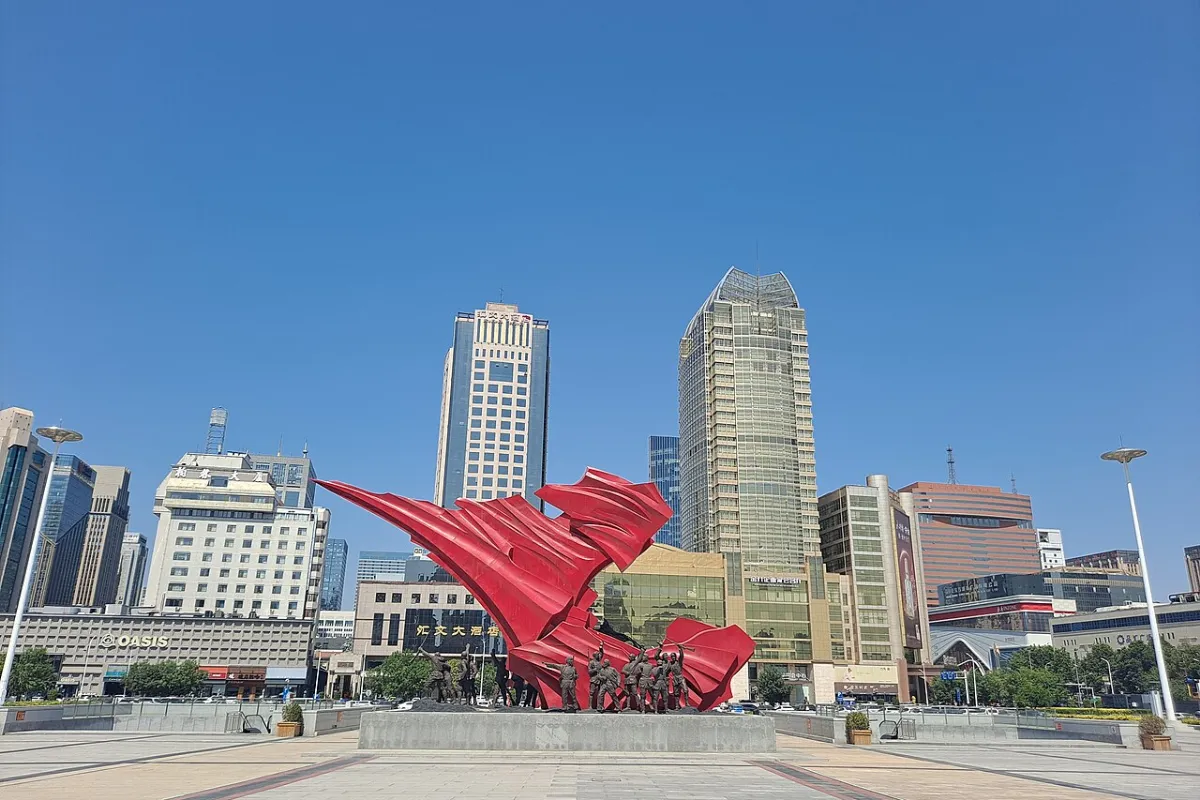
石家庄市
A rail junction that became a provincial capital — and the doorway to Zhengding, Zhaozhou and the Taihang hills
Why this place
Shijiazhuang was a village of a few hundred people until two railway lines crossed here in 1907; it replaced Baoding as the capital of Hebei in 1968. The city itself is modern and functional rather than scenic — what earns it a stop is what sits within an hour of it: a county town with four pagodas, a Sui-dynasty bridge that was the longest stone arch in the world, and the first foothills of the Taihang mountains. Think of it as a base, not a destination.
People and culture
- Shijiazhuang is the textbook Chinese city built by railways: the line to Taiyuan met the Beijing–Hankou line here in 1907, and the village grew into an industrial city around the junction. Locals call it 'the city the train dragged in'.
- Zhengding, 15km north, was the real city for most of history. Its Longxing Temple holds a 21.3-metre bronze Guanyin with 42 arms, cast in 971 on the orders of the Song founder and standing on a two-metre stone base — the tallest surviving ancient bronze Buddhist statue in China.
- The Zhaozhou bridge at Zhaoxian, 40km southeast, was built by the mason Li Chun between 595 and 605. Its single open-spandrel arch spans 37 metres, it was still carrying road traffic in 1984, and the American Society of Civil Engineers listed it in 1991 as an international historic civil-engineering landmark — the only one in China.
- The Warring States state of Zhongshan had its capital in the hills west of the city. Its tombs, excavated in the 1970s, produced some of the finest bronze work ever found in China, including a plan of the royal tomb precinct cast in gold and silver — the earliest architectural drawing known from China.
- Xibaipo, a village 90km west in the mountains, was the headquarters of the Communist Party from 1948 to 1949. Three decisive campaigns of the civil war were directed from its courtyards, and the Party's second plenum met in its own village hall.
What to see
- Zhengding old town Longxing Temple and its 21-metre bronze Guanyin, then four ancient pagodas, a Tang bell tower and the Confucian temple, all inside a square kilometre you can walk
- The Zhaozhou bridge at Zhaoxian the 1,400-year-old open-spandrel arch, free to enter since late 2023
- The Hebei Museum in the city the Han jade burial suits and the bronzes from the Zhongshan tombs
- Cangyan Mountain, 50km southwest, where the Suspended Temple clings to a cliff face above a gorge
- The Taihang foothills west of the city, for a half-day of walking
What to eat
- Donkey-meat burger (lürou huoshao) shredded donkey meat with green pepper in a flaky sesame bun, the regional snack
- Anhui-style banmian flat hand-pulled wheat noodles in chilli oil, which the city has adopted so thoroughly that every neighbourhood has a stall
- Oven-baked sesame cakes (ganglu shaobing) and the mutton soups of the Hui quarter
How to plan
Two days. Day one to Zhengding, 20 minutes out on metro line 1 plus a short bus: Longxing Temple in the morning, then the four pagodas, the bell tower and the Confucian temple on foot — the whole old town is an afternoon's walk. Day two: the Zhaozhou bridge at Zhaoxian in the morning (40 minutes by bus or car), the Hebei Museum back in the city in the afternoon. With a car, add a third day for Cangyan Mountain and the Taihang foothills.
Best time
April–May and September–October
Practical tips
- You do not need a tour for Zhengding: metro line 1 runs to Zhengding station, then a local bus. Taxis from the centre are cheap too.
- The Hebei Museum is free and closes on Mondays; the ticket desk wants your passport.
- The Zhaozhou bridge site has been free since late 2023, but it is 42km out and the last bus back fills up — check return times before you go.
HSKHSK level 2
This browser has no speech synthesis, so the ▶ buttons stay silent. Everything else works — Chrome, Edge and Safari can read the sounds aloud.