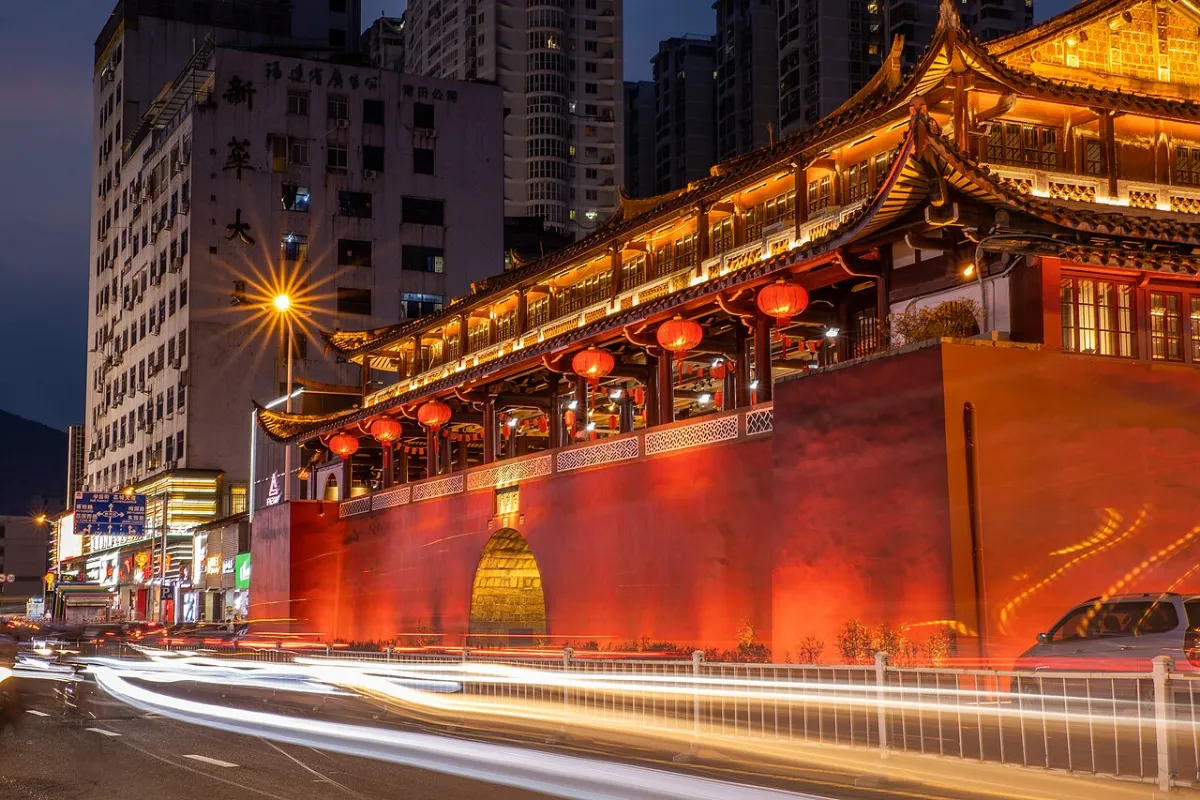
Why this place
Putian is a coastal prefecture in central Fujian whose identity rests on two things: the sea goddess Mazu, born on its Meizhou Island, and shoes — it is one of the largest footwear manufacturing bases in China. Meizhou is the spiritual home of Mazu worship, followed by fishing and trading communities all around the South China Sea and across the Taiwan Strait. Inland, the prefecture's plain is dense with villages and ancestral halls, and the hills to the west hold Buddhist and Taoist sites.
People and culture
- Mazu began as Lin Mo, a girl of Meizhou Island said to have lived in the 10th century and to watch over sailors; after her death she became the protector of the sea, and the faith now has temples from Fujian to Southeast Asia and along every Chinese coast.
- The Mazu ancestral temple on Meizhou is the model for thousands of daughter temples; pilgrims cross from Taiwan, China by the boatload for her birthday in the third lunar month, and the island's rituals are on the national intangible-heritage list.
- Putian's other craft is the shoe: whole towns here make trainers and sandals for global brands, and the local supply chain — from stitching to sole-moulding — is concentrated enough that a sample can be turned around in days.
- The prefecture also keeps a strong line in Guanghua Temple, a Buddhist monastery with a long textual tradition, and in the carved stone of the Hanjiang plain's old bridges.
What to see
- Meizhou Island and the Mazu ancestral temple, with the statue, the pilgrims' steps and the coast path
- Guanghua Temple in the city, one of Fujian's older Buddhist monasteries
- Jiuli Lake (Jiulihu) in Xianyou county a chain of waterfalls and a Taoist retreat in the hills
- The old lanes of Hanjiang and the surrounding village ancestral halls
- The coastal beaches of the prefecture and the south Shawei shore
- The shoemaking towns such as Licheng, where the industry is visible in every workshop
What to eat
- Putian braised mixed dishes (lu cai) a spread of soy-braised pork, tofu and offal served in the local banquet style
- Meizhou seafood whelks, razor clams and grouper simply steamed
- Litchi and longan, both grown in the warm prefecture plain in season
- Putian rice noodles (xinghua mi xian), thin and springy, in a clear pork-and-seaweed broth
How to plan
Two days. Day one on the coast: ferry to Meizhou Island in the morning to see the Mazu temple and walk the shoreline, back to the city for a seafood dinner. Day two inland: the Jiuli Lake waterfalls at Xianyou and the old Guanghua Temple, or a slow wander through Hanjiang's village lanes and ancestral halls. If you care about the shoemaking economy, a morning in Licheng's workshop district shows how a pair of shoes is actually put together.
Best time
March–May and October–December; Mazu's birthday falls in the third lunar month
Practical tips
- The Meizhou ferry runs on a timetable that thins in the afternoon — go early and check return times before you leave the island
- Mazu's birthday in the third lunar month brings huge crowds and booked-out ferries; visit off-season for a calmer island
- Putian's signature food is the braised banquet set, not street snacks — order it as a table meal rather than expecting single plates
HSKHSK level 3
This browser has no speech synthesis, so the ▶ buttons stay silent. Everything else works — Chrome, Edge and Safari can read the sounds aloud.