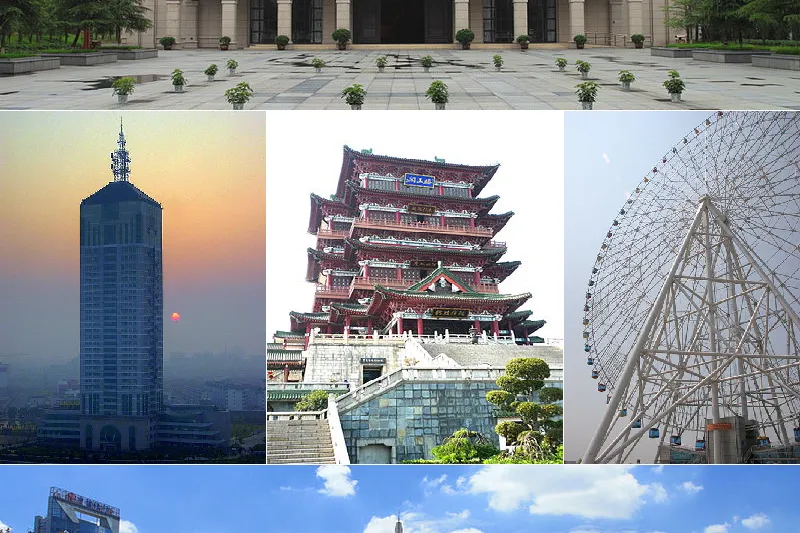
Why this place
Nanchang is the capital of Jiangxi, on the Gan River, and its Tengwang Pavilion has been one of the great literary landmarks of China since the Tang dynasty — rebuilt many times, most recently in 1989, but still the pavilion of Wang Bo's essay. The city also marks the founding of the People's Liberation Army, and since 2011 it has held the tomb of the Marquis of Haihun, the richest Western Han excavation ever made in China.
People and culture
- Tengwang Pavilion exists because of one poem. Wang Bo wrote his 'Preface to the Pavilion of Prince Teng' in 675, at a banquet, reputedly without preparation; the line 'the sunset clouds and the lone duck fly together, autumn water and the vast sky share one colour' made the building famous for the next 1,300 years. It has been destroyed and rebuilt some 29 times.
- The tomb of the Marquis of Haihun was found in 2011 and excavated from 2015. The occupant was Liu He, who was emperor for 27 days before being deposed — the only man in Chinese history to be a king, an emperor, a commoner and a marquis. His grave had never been robbed: it yielded 478 gold objects weighing over 115 kilograms, some ten tonnes of Han coins, and 5,200 bamboo slips including a copy of the lost 'Qi Analects'.
- The same tomb produced a lacquered mirror screen painted with Confucius and his disciples — the earliest known portrait of Confucius anywhere, made within a century of the emperor who made Confucianism the state doctrine.
- On 1 August 1927 the Communist rising in Nanchang opened the civil war; the date is still Army Day. The city is also the home of Bada Shanren, the Ming prince turned monk whose ink-and-brush paintings made him the founder of Chinese expressionist painting.
What to see
- Tengwang Pavilion a 1989 rebuilding on the original site, but the view over the Gan River is the one in the poem
- The Museum of the Marquis of Haihun State at Datangping, an hour out of the city gold, coins, chariots and the earliest Confucius portrait
- Bayi Square and the Uprising Memorial, at the heart of the city
- Bada Shanren Memorial Hall at Qingyunpu, the painter's garden retreat
- Poyang Lake and its wintering birds, an hour north the largest freshwater lake in China, and the winter home of Siberian cranes
- Wanshou Palace and the restored old city quarter around it
What to eat
- Nanchang rice noodles (ban fen) with chilli and pickles, eaten with a jar of slow-simmered soup (waguan tang) this pair is the city's breakfast, and locals are partisan about which stall does it best
- Lihao stir-fried with cured pork a wild vegetable from the Poyang Lake shore, in season in spring
- Nanchang fried rice noodles, and the local stews, which are genuinely hot
How to plan
Two days. Day one in the city: Tengwang Pavilion in the morning, the Wanshou Palace quarter and Bayi Square on foot in the afternoon. Day two out to the Haihun Marquis museum (about an hour by car or the shuttle), back in the city by late afternoon. In winter, add a third day for Poyang Lake — the cranes are the reason to come in December or January.
Best time
March–May and October–November; December–February for Poyang Lake's birds
Practical tips
- The Haihun museum needs a booking and closes on Mondays; it is 60km from the centre, so either take the shuttle or hire a car for the morning.
- Tengwang Pavilion is a modern rebuilding — go for the river view and the poem, not for old timber.
- Nanchang food is seriously hot. 'Wei la' means mildly hot, which is still hot; say 'bu la' if you mean it.
HSKHSK level 3
This browser has no speech synthesis, so the ▶ buttons stay silent. Everything else works — Chrome, Edge and Safari can read the sounds aloud.