Why this place
Luoyang was the capital of thirteen dynasties and it is the place where Buddhism established itself in China - the White Horse Temple was the first, and the Longmen Grottoes are the greatest collection of Buddhist carving in the country. It is also the peony capital, with the flower that the Tang court made its own. The city lay on the Luo River road between Chang'an and the east, which is why so many dynasties chose it; its eastern cliffs hold the Longmen carvings and its gardens the peony the Tang adopted as an emblem.
People and culture
- Luoyang was a capital to thirteen dynasties, from the Eastern Zhou in the 8th century BC to the Later Tang in the 10th. The Han and the Tang both ruled from here for long stretches, which is why the city's archaeology is deeper than Xi'an's in places.
- The White Horse Temple of 68 AD is the first Buddhist temple built in China - the religion arrived with two monks and a white horse, and the temple their grooms built is still standing on the same site.
- Erlitou, in the Yanshi district, is the site most archaeologists identify with the Xia dynasty, the shadowy first dynasty of the traditional list.
- Peonies are the city's emblem, cultivated here since the Tang, and the April peony festival is the reason to time a visit rather than avoid one.
- Xuanzang, the monk who walked to India and came back with the sutras that became Journey to the West, was born in Yanshi, just outside the city.
What to see
- Longmen Grottoes - 2,300 caves and niches, 100,000 figures, and the great Vairocana Buddha
- The White Horse Temple, founded in 68 CE, the first Buddhist temple in China
- The Luoyang Museum and the Luoyang Ancient Art Museum, with tomb figures and Tang ceramics
- The peony gardens, flowering in mid-April
- Guanlin, the temple-mausoleum said to hold Guan Yu's head, a large Ming shrine
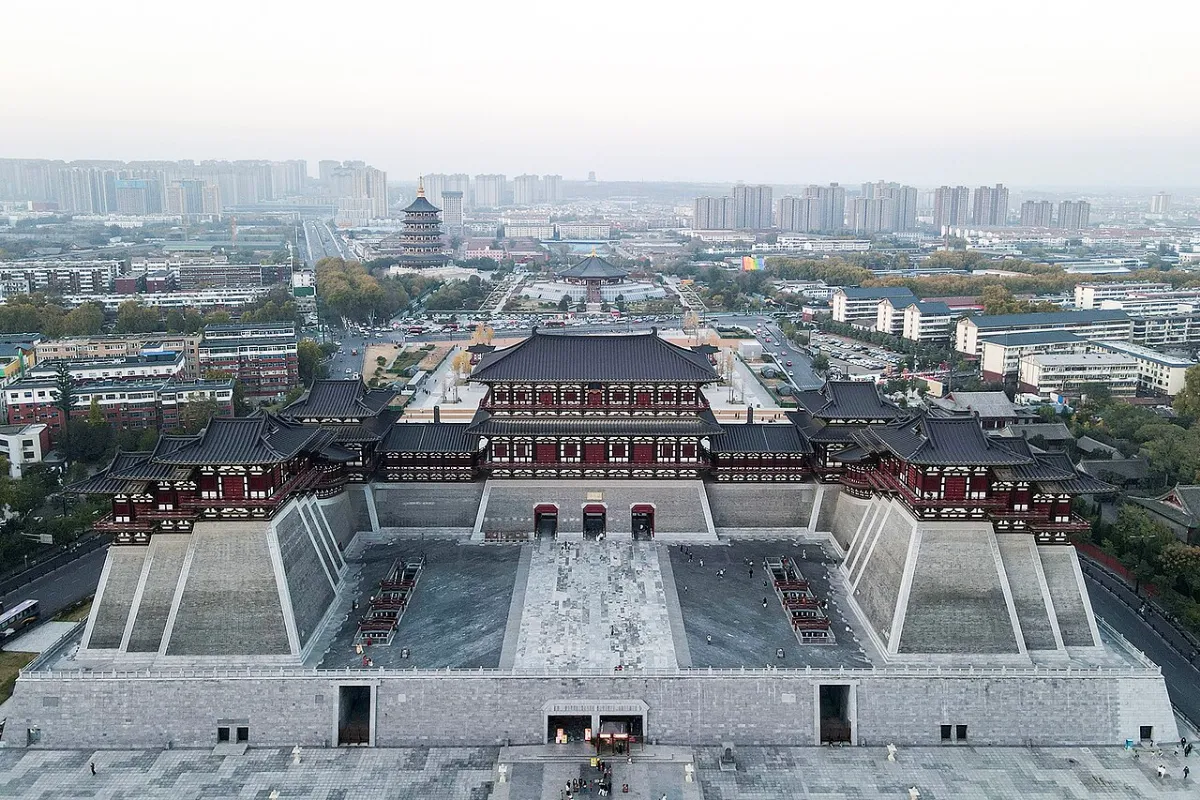
- The Sui-Tang Luoyang city ruins park, where the grid of the medieval capital is marked on the ground
What to eat
- Luoyang water banquet (shuixi) - a whole formal meal tradition of soup dishes served in sequence
- Luoyang bufan - a thick soup with shredded pancake, a breakfast staple
- Peony-themed confectionery, sold everywhere in April
- Wide rice noodles stir-fried with mutton, a local wheat-and-river dish
How to plan
Allow two days. Day 1: the Longmen Grottoes on the city's southeast edge - allow half a day to walk both banks and see the Vairocana Buddha, then return for the Luoyang Museum and its Tang tomb figures. Day 2: the White Horse Temple, China's first Buddhist foundation, and the Guanlin shrine, with the peony gardens in between if you visit in April. Luoyang is an hour by high-speed rail from Zhengzhou and links onward to Xi'an, so it fits a plain-and-capital loop neatly.
Best time
Mid-April for the peonies; April-May and September-October generally
Practical tips
- Longmen is best in the late afternoon, when the light hits the big Buddha and the tour groups leave
- The grottoes are two sites on opposite banks linked by a bridge - the ticket covers both, and there is a boat back if you have had enough walking
- The peony gardens are only worth it in mid-April; at other times the city's main draw is the carving and the temples
This browser has no speech synthesis, so the ▶ buttons stay silent. Everything else works — Chrome, Edge and Safari can read the sounds aloud.