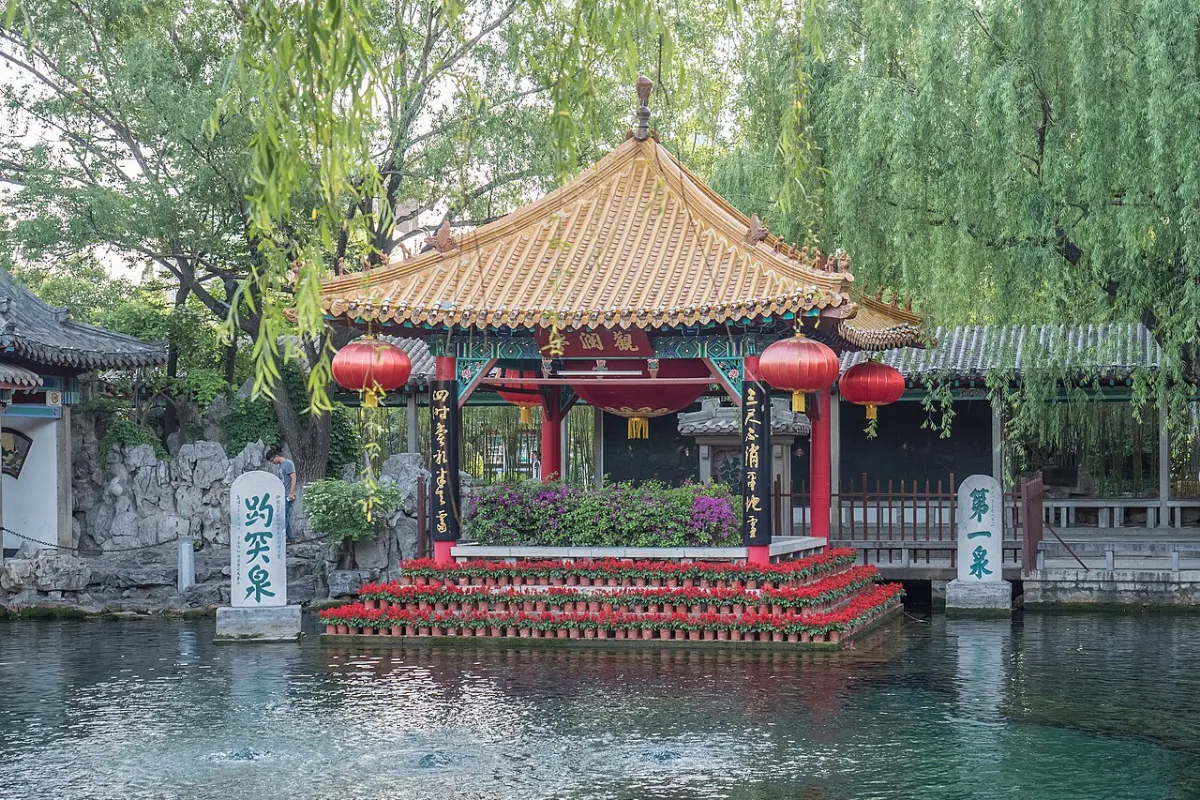
Why this place
Jinan is the city of springs: artesian water rises through the middle of the city, and the springs are protected by law. It has been a capital for over two thousand years — under the Zhou, the Han and every dynasty since — because it sits where the foothills of Mount Tai meet the Yellow River plain. Mount Tai itself, the most sacred of China's five great mountains, is 20 minutes away by high-speed train.
People and culture
- The springs are geology, not decoration. Rain falling on the north slope of Mount Tai sinks into limestone, runs underground, and is forced back up where the rock meets an impermeable layer under the city. Jinan has more than a hundred spring outlets; 72 of them are named, and Baotu Spring has been called the finest under heaven since the Qing emperors inscribed it.
- Chengziya, a mound east of the city, is where Chinese archaeology began: excavated in 1928, it gave its name to the Longshan culture and its eggshell-thin black pottery, made on a fast wheel four thousand years ago.
- Two of the greatest Song-dynasty poets were born here — Li Qingzhao, the finest woman poet in the language, and Xin Qiji, who wrote his ci while campaigning against the Jin. Locals call the pair 'the two An of Jinan' after their courtesy names.
- Lingyan Temple, in the hills an hour south, holds a set of painted clay luohan figures from the Song dynasty that Liang Qichao called the finest sculpture in China. Its nine-storey Pagoda of the Pratyeka Buddha is one of the oldest brick pagodas still standing.
What to see
- Baotu Spring and the spring pools around it the one the Qianlong emperor called the first spring under heaven, best after the summer rains
- Daming Lake and its park, the big water at the north edge of the old city
- The old city on foot: Kuanhou Suo, Furong Street and Qushuiting Street, where the springs run in open channels past the houses
- Qianfo Mountain (Thousand Buddha Mountain) with its Sui-dynasty carved Buddhas and a view back over the city
- Lingyan Temple in Changqing Song-dynasty luohan sculpture and the old pagoda, an hour out and far quieter than the city sights
- The Shandong Museum, which holds Han stone carvings, oracle bones and a good prehistoric gallery
What to eat
- Shandong cuisine is one of the eight great traditions the braised sea cucumber and the sweet-and-sour carp are the dishes to order
- Bazi rou a slab of pork belly braised in soy and tied with string, served over rice with greens; the city's everyday lunch
- Sweet porridge (tianmo, which is not actually sweet) with a flaky youxuan spiral, the traditional Jinan breakfast
- Spring-water tofu dishes, and the guoba (crisp rice crust) that the city is known for
How to plan
Two days for the city, plus one for Mount Tai. Day one: Baotu Spring in the morning, then walk the old city — Furong Street and Qushuiting Street — to Daming Lake in the afternoon. Day two: Qianfo Mountain in the morning and the Shandong Museum after lunch, or take the whole day for Lingyan Temple if you have a car. Mount Tai is a separate day: high-speed trains run to Tai'an in 20 minutes, and the classic climb is up the east route and down by cable car.
Best time
April–May and September–October; the springs are strongest after the summer rains
Practical tips
- Give Mount Tai its own day rather than bolting it onto a Jinan day — the climb is 6,000-odd steps and the last section is steep.
- The springs are at their best from August to October after the rains; in a dry spring some of the smaller ones stop flowing.
- Lingyan Temple is 1.5 hours out in Changqing and gets a fraction of the city crowds — worth it if you have a car.
HSKHSK level 3
This browser has no speech synthesis, so the ▶ buttons stay silent. Everything else works — Chrome, Edge and Safari can read the sounds aloud.